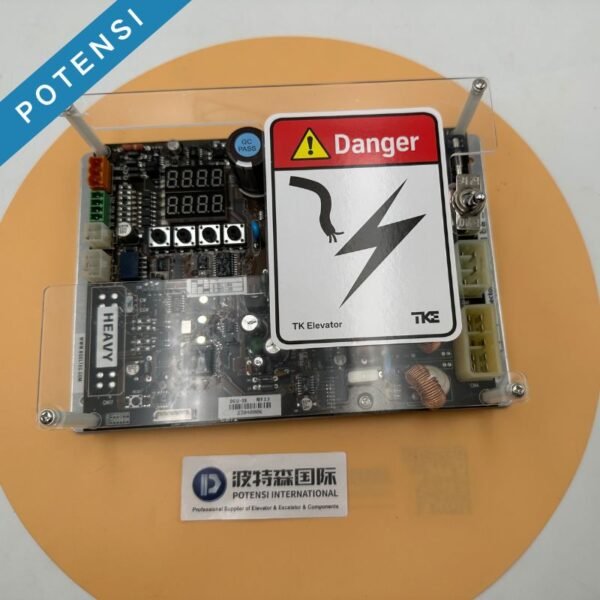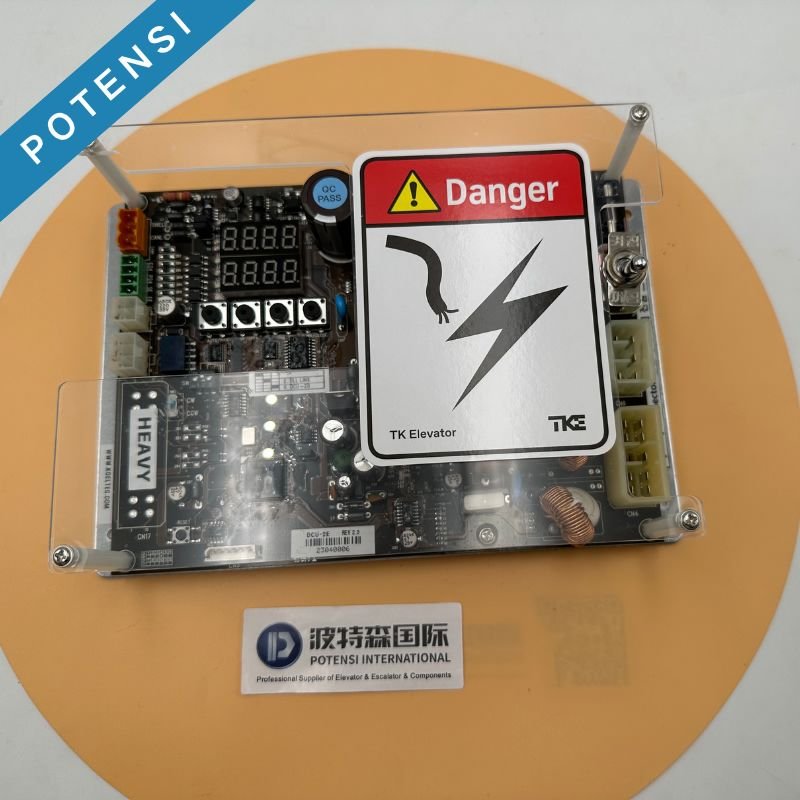
DCU-2E is the car door control board on TKE Dongyang lifts: the board that runs the door operator motor, reads the open and close limits, the safety edge and the encoder, and talks to the controller over CAN. A failing board shows as a door that stalls, reverses without cause or ignores the open button. This is the REV 2.3 build, marked on the PCB. Dongyang is TKE’s Korean works, so the board sits in Korean-built cars.
Quer se trate de um grossista ou mesmo de uma empresa de manutenção, a POTENSI é o ONE-STOP-SHOP para todas as peças de que necessita.
Na POTENSI, o nosso objetivo é ajudá-lo a aceder facilmente a todos os tipos de clientes ou a todas as marcas de elevadores, graças aos nossos 21 anos de experiência na indústria de elevadores da China.
A missão da POTENSI é ajudá-lo a ter sucesso e a melhorar a segurança dos edifícios em todo o mundo com peças para elevadores de alta qualidade e um serviço excecional.
A rapidez de entrega é o nosso ponto forte, mas o que nos torna diferentes de todos os outros é a nossa oferta multimarcas. Comprar na POTENSI é tão fácil quanto possível, com mais de 200K de peças multimarcas.
A nossa loja virtual está aberta 24 horas por dia, 7 dias por semana. Assim que registado Como nosso membro, obterá muitas vantagens e poderá encontrar a peça de que necessita com qualquer código e obter o nosso serviço VIP por um especialista de vendas.
Para garantir a alta qualidade, a POTENSI fornece peças apenas dos fabricantes de equipamentos originais ou dos seus fornecedores diretos. Se colaborar com a POTENSI, terá a garantia de sucesso perante os seus clientes.
| Característica | Especificações |
|---|---|
| Número do modelo | DCU-2E REV 2.3 |
| Também escrito como | DCU2E, DCU 2E, door control unit DCU-2E, TKE Dongyang door board, PCB DCU-2E |
| Marca | TKE |
| Tipo de produto | Door control board (PCB) |
| Função | Runs the car door operator, limits, safety edge, encoder and CAN link |
| Utilizado em | TKE Dongyang (Korea) lifts, car door operator |
| Compatibilidade | REV 2.3; DCU-2C and DCU-2D are other versions |
Door control board versions, and the Korean range boards that sit with it.
Door control board versions:
Other boards in the same range:
Potensi supplies the TKE elevator door control board DCU-2E REV 2.3 and the TKE Dongyang board range around it. The models above are only a part of what we can supply. We stock and source a much wider range of related and alternative models. If your model number is not listed here, please send us the model number or a photo of the original part, and we will confirm availability and the correct match for you.
Q1: What does the DCU-2E control?
R: It is the board that runs one car door: three-phase output to the door motor from a single-phase 220 V supply. It reads the door open and door close limit signals, takes the safety edge and light curtain inputs, and uses the encoder for position and speed. Communication with the lift controller goes over CAN, so the door orders and the door status travel on the bus rather than on a bank of relays.
Q2: Does the revision number matter?
R: Yes. These boards carry a revision marking, and REV 2.3 is the build quoted here. A board from another revision may look identical and still differ in the parts fitted or in the program it carries. Quote the marking on your board together with the model, because the model alone does not identify the build.
Q3: What does a failing board look like?
R: A door that stops halfway, reverses with nothing in the light curtain, or refuses to open when the button is pressed. It can also show as a door that runs but never reports closed, so the lift holds at the floor. Before condemning the board, look at the limits and the safety edge: a misadjusted vane or a dirty light curtain gives the same symptoms.
Q4: Is it used on all TKE lifts?
R: No. It belongs to the Dongyang range, which is TKE’s Korean-built equipment, and it is the board inside those car door operators. European-built TKE machines use different door control boards, and the two families do not interchange. Tell us the controller model and the country of build, and we will confirm that the Dongyang board is the right one.
Q5: What is needed after fitting?
R: The door has to be set up again: the width and travel are taught in, and the encoder direction is confirmed before the door runs in service. This is the step that decides whether a new board works on the first ride or trips an obstruction or calibration fault. Have the door free to cycle through its full travel when the board is fitted.
Q6: What should I send with the request?
R: Photos of the board front and back, with the DCU model and the REV marking readable. The car door operator type, the controller model, and whether the doors are centre or side opening. The fault as it appears on site, and whether the board was damaged by water, a short or a motor fault, since a repeat failure usually comes from outside the board.
① Obtenha 10% de desconto na sua primeira encomenda.
② Receba as últimas notícias sobre os nossos produtos em promoção.
③ Obtenha o serviço VIP do nosso especialista de vendas 24/7.
④ Tenha acesso ao nosso prazo de pagamento a crédito.

WhatsApp-nos