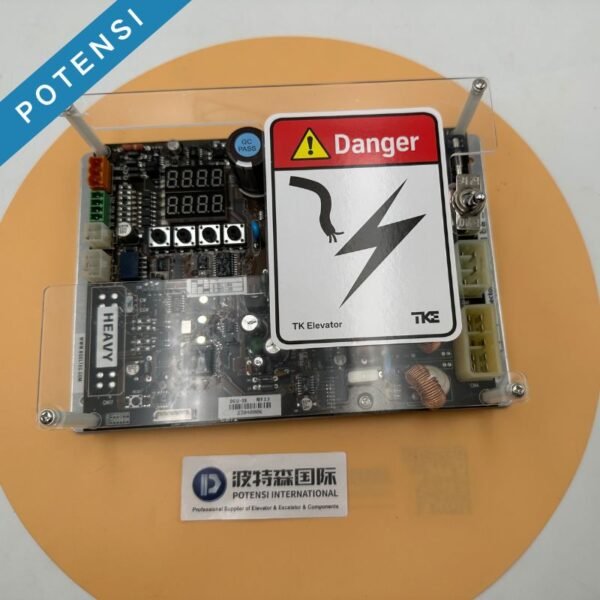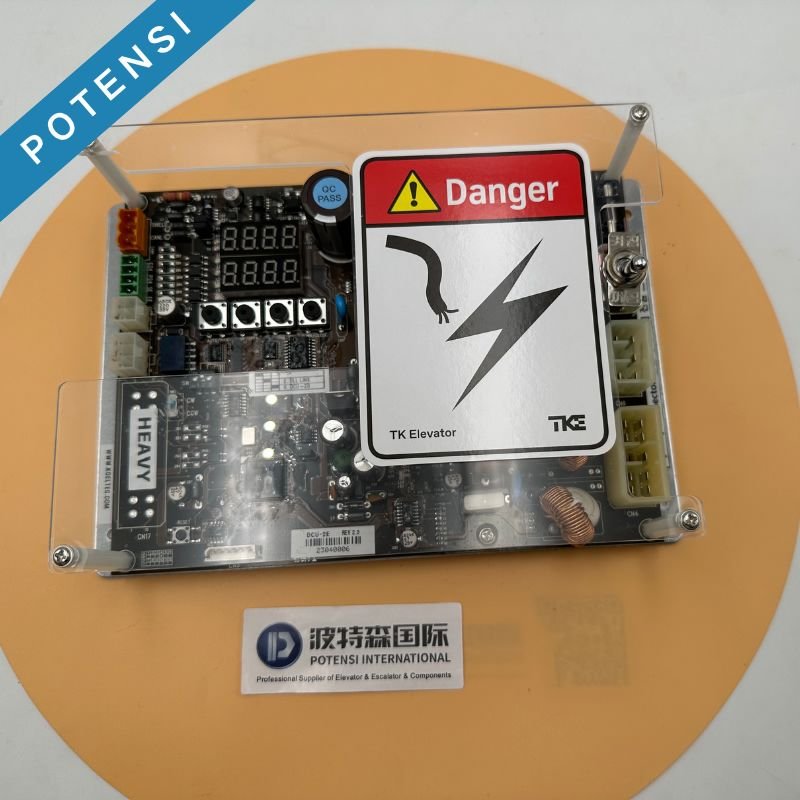
DCU-2E is the car door control board on TKE Dongyang lifts: the board that runs the door operator motor, reads the open and close limits, the safety edge and the encoder, and talks to the controller over CAN. A failing board shows as a door that stalls, reverses without cause or ignores the open button. This is the REV 2.3 build, marked on the PCB. Dongyang is TKE’s Korean works, so the board sits in Korean-built cars.
Whether you are a wholesaler or even maintenance company, you will find POTENSI is the ONE-STOP-SHOP for all the parts you need.
At POTENSI, our focus is to help you access to all kind of clients or all brand elevator easily with our 21 years experience in China elevator industry.
POTENSI mission is to help you to succeed and enhance building safety worldwide with top-quality elevator parts and outstanding service.
Delivery speed is our strength, but what make us different from everyone else is our multi-brand offering. Purchasing from POTENSI is as easy as it gets with 200K+ multi-brand parts.
Our web shop is open 24hours, 7days a week. Once you registered as our member, you will get many great benefits and you are able to find the part you need with any code and get our VIP service by sales specialist.
To ensure high quality, POTENSI provide parts only by original equipment manufacturers or their direct suppliers. You cooperate with POTENSI , you get the insurance of succeed when you are facing your customers.
| Feature | Specification |
|---|---|
| Model Number | DCU-2E REV 2.3 |
| Also Written As | DCU2E, DCU 2E, door control unit DCU-2E, TKE Dongyang door board, PCB DCU-2E |
| Brand | TKE |
| Product Type | Door control board (PCB) |
| Function | Runs the car door operator, limits, safety edge, encoder and CAN link |
| Used On | TKE Dongyang (Korea) lifts, car door operator |
| Compatibility | REV 2.3; DCU-2C and DCU-2D are other versions |
Door control board versions, and the Korean range boards that sit with it.
Door control board versions:
Other boards in the same range:
Potensi supplies the TKE elevator door control board DCU-2E REV 2.3 and the TKE Dongyang board range around it. The models above are only a part of what we can supply. We stock and source a much wider range of related and alternative models. If your model number is not listed here, please send us the model number or a photo of the original part, and we will confirm availability and the correct match for you.
Q1: What does the DCU-2E control?
A: It is the board that runs one car door: three-phase output to the door motor from a single-phase 220 V supply. It reads the door open and door close limit signals, takes the safety edge and light curtain inputs, and uses the encoder for position and speed. Communication with the lift controller goes over CAN, so the door orders and the door status travel on the bus rather than on a bank of relays.
Q2: Does the revision number matter?
A: Yes. These boards carry a revision marking, and REV 2.3 is the build quoted here. A board from another revision may look identical and still differ in the parts fitted or in the program it carries. Quote the marking on your board together with the model, because the model alone does not identify the build.
Q3: What does a failing board look like?
A: A door that stops halfway, reverses with nothing in the light curtain, or refuses to open when the button is pressed. It can also show as a door that runs but never reports closed, so the lift holds at the floor. Before condemning the board, look at the limits and the safety edge: a misadjusted vane or a dirty light curtain gives the same symptoms.
Q4: Is it used on all TKE lifts?
A: No. It belongs to the Dongyang range, which is TKE’s Korean-built equipment, and it is the board inside those car door operators. European-built TKE machines use different door control boards, and the two families do not interchange. Tell us the controller model and the country of build, and we will confirm that the Dongyang board is the right one.
Q5: What is needed after fitting?
A: The door has to be set up again: the width and travel are taught in, and the encoder direction is confirmed before the door runs in service. This is the step that decides whether a new board works on the first ride or trips an obstruction or calibration fault. Have the door free to cycle through its full travel when the board is fitted.
Q6: What should I send with the request?
A: Photos of the board front and back, with the DCU model and the REV marking readable. The car door operator type, the controller model, and whether the doors are centre or side opening. The fault as it appears on site, and whether the board was damaged by water, a short or a motor fault, since a repeat failure usually comes from outside the board.
① Get 10% off on your first order.
② Get latest news about our promotion products.
③ Get our sales specialist VIP service 24/7.
④ Get access to our credit payment time.

WhatsApp us