A lift cannot be judged by looking at it. The doors close, the car moves, nothing sounds wrong. The brake may be releasing late. The governor may trip at the wrong speed. A rope may be one journey from failing. None of that is visible from the landing.
Some of it is written down inside the controller. The rest has to be measured.
Elevator testing tools do those two jobs. They read what the controller recorded, and they measure what the controller cannot see. The two jobs are different, and so are the tools.
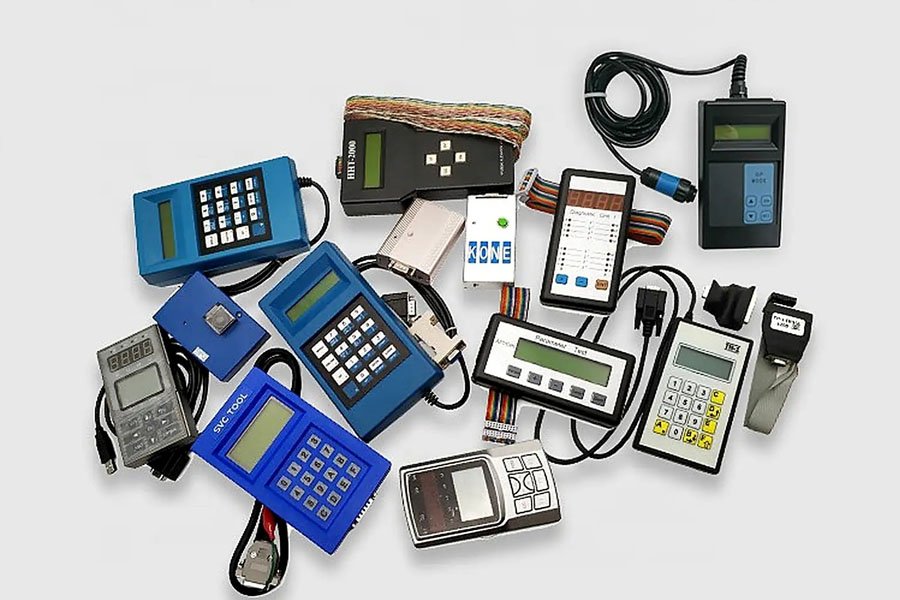
Most lifts built since the 1990s have a small port in the control cabinet. Plug a service tool into it, and the tool and the controller start a conversation. That port is what most elevator testing tools are built to plug into. The tool asks questions. The controller answers from its own memory.
Think of the diagnostic socket in a car. A mechanic plugs in, reads the stored faults, watches live values, and clears the code once the repair is done. An elevator service tool does the same three things:
The tool is not part of the lift. It does not travel with the car. It is a window and a keypad, not a repair. What it shows still has to be interpreted, and what it changes still has to be measured afterwards.
Older lifts without a port are not tested with a service tool. They are tested with meters, gauges and judgement, which is why the other families below exist.
| Family | What it answers | Usual form |
|---|---|---|
| A. Controller service tools | What does the controller think is wrong? | Handheld or laptop |
| B. Electrical instruments | Is the power and wiring sound? | Portable meters |
| C. Safety-part testers | Do the safety devices act at the right point? | Dedicated rigs |
| D. Load and balance testing | Does it behave the same with the rated load? | Weights or load cells |
| E. Bus and signal diagnostics | Is the data arriving intact? | Analyser, oscilloscope |
| F. Adapters and licences | Can the tool connect at all? | Cables, dongles |
The order follows a call-out. The controller is asked first because it is fastest. If it reports nothing, the meter comes out. If the fault only appears under load, family D comes in. No single elevator testing tool covers the whole list.
Four sub-types. All of them read or write the controller’s memory.
| Sub-type | What it is | Utilização típica |
|---|---|---|
| A1. Handheld terminal | Dedicated keypad and screen | Fault codes, parameters, test runs on a call-out |
| A2. Laptop software | PC tool plus cable | Full parameter sets, logs, job files |
| A3. Board-level programmer | Bench device with adapters | Giving a replacement board its program |
| A4. Simulator or test box | Signal source | Testing a controller with no lift around it |
A1 is what most people mean by an elevator testing tool. It is fast, and it fits in one hand. It answers the question the passenger is asking: why did it stop?
A2 does the same job with more depth. Parameter sets can be saved, compared and copied between lifts, which is what a modernisation or a board swap needs.
A3 is the one people outside the trade never see. A replacement board arrives without its program. The programmer writes it, on a bench, before the board goes into a shaft.
A4 is a workshop item. It feeds the controller the signals a lift would feed it, so a fault can be reproduced without a building.
What family A cannot tell you. Voltage, insulation resistance, brake force, door closing force. A service tool reporting “no fault” means the controller is content with the inputs it can see. It says nothing about a cable that is about to fail.
Six sub-types. None of them is built for lifts, yet every elevator testing toolkit ends up holding all six.
| Sub-type | Measures | Finds |
|---|---|---|
| B1. Multimeter | Voltage, resistance, continuity | Broken control circuits, dead coils |
| B2. Clamp meter | Current without opening the circuit | Motor current, brake coil current |
| B3. Insulation tester | Resistance at 500 V or 1000 V | Damaged travelling cable, damp windings |
| B4. Earth and continuity tester | Bonding resistance | Missing or high-resistance earth |
| B5. Phase sequence tester | Rotation order | Wrong rotation after a supply change |
| B6. Oscilloscope | Waveform over time | Missing encoder edges, noise on a bus |
B3 finds what a multimeter misses. A damaged travelling cable can read perfectly on a low-voltage continuity test. At 500 V it fails.
Five sub-types. These answer an inspector’s question, not a passenger complaint.
| Sub-type | Checks |
|---|---|
| C1. Governor tester | The speed at which the overspeed governor actually trips |
| C2. Brake tester | Retardation or braking torque under load |
| C3. Buffer check | Stroke and reset of the buffers |
| C4. Door force gauge | Closing force and kinetic energy |
| C5. Load cell and calibration set | Car weight, overload device trip point |
A service tool knows what the controller was told. A governor tester knows what the governor did. Those are different facts, and only one of them is evidence.
| Sub-type | Method | Used for |
|---|---|---|
| D1. Test weights | Physical weights in the car | Acceptance, and jurisdictions that still require them |
| D2. Electronic Category 5 | Load cells and a logger | Periodic testing without moving tonnes of steel |
| D3. Balance coefficient test | Current at 40 and 50 percent load | Setting the counterweight correctly |
D1 and D2 answer the same question by different routes. D3 is not a test in the legal sense. It is how the machine is set up, so it does not work against itself for ten years.
| Sub-type | Measures | Used when |
|---|---|---|
| E1. CAN analyser | Traffic, error frames, node presence | A bus fault that moves when the car moves |
| E2. Cable and termination tester | Continuity, shield, terminating resistance | After a travelling cable replacement |
| E3. Encoder signal tester | Pulse count, phase, missing edges | Speed feedback faults, levelling drift |
Family E is the last resort, and the most decisive. When a fault survives three board swaps, the board was never the problem.
| Sub-type | Covers | Por que é importante |
|---|---|---|
| F1. Cables and converters | Port adapters, USB to serial, optical heads | A tool without the right connector cannot connect |
| F2. Licence and dongle | Software entitlement per controller family | The box is cheap; the entitlement is not |
| F3. Manuals and training | Parameter lists, fault code tables | The tool shows a code; the document says what it means |
F is where budgets go wrong. Buyers compare the price of the box. They forget the licence, the adapter set and the current manual are part of the working system.
| Form | Works where | Limitação |
|---|---|---|
| Handheld | Shaft, car top, pit | Small screen, no logging |
| Laptop | Machine room, office | Needs power and boot time |
| Bench | Workshop | The board must be out of the lift |
| In-line | Permanently installed | A monitoring product rather than a tool |
| What you see | Start with | Then |
|---|---|---|
| Car stops between floors | A1: read the fault log | E3 if the log points at speed feedback |
| Annual inspection due | C1 and C4 | B3 on the travelling cable |
| New installation | A2: parameters | D3 balance, D1 or D2 proof |
| Rough ride, no fault code | B6: waveform | B3 insulation |
| Fault returns after a board swap | E1: bus traffic | E2 cable and termination |
| Overload device trips early | C5 load cell | D3 balance |
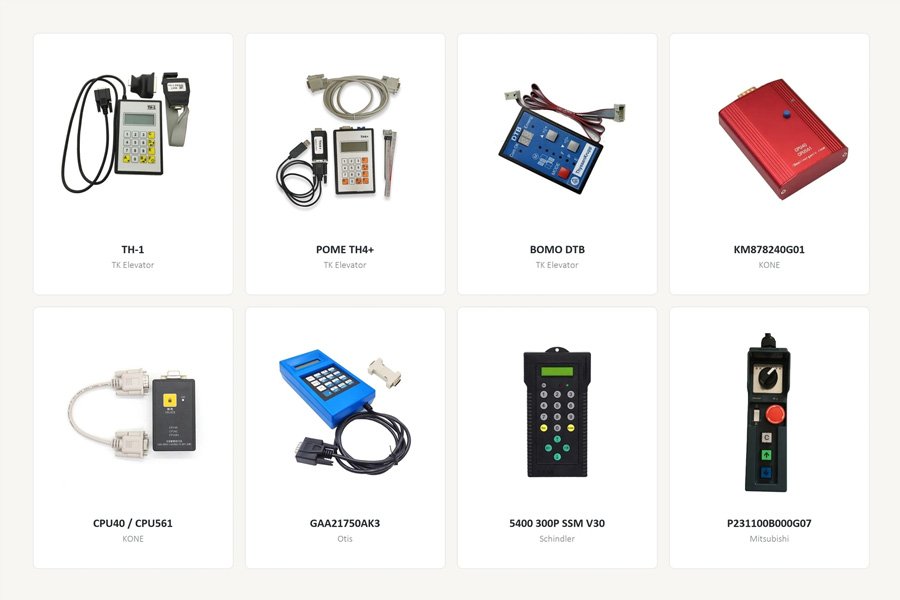
Families and roles follow current maintenance practice and parts catalogues. Model names such as TH-1, GAA21750AK3 and CPU561 are examples in circulation, not a compatibility list. The Category 5 comparison follows Elevator World, February 2025.