
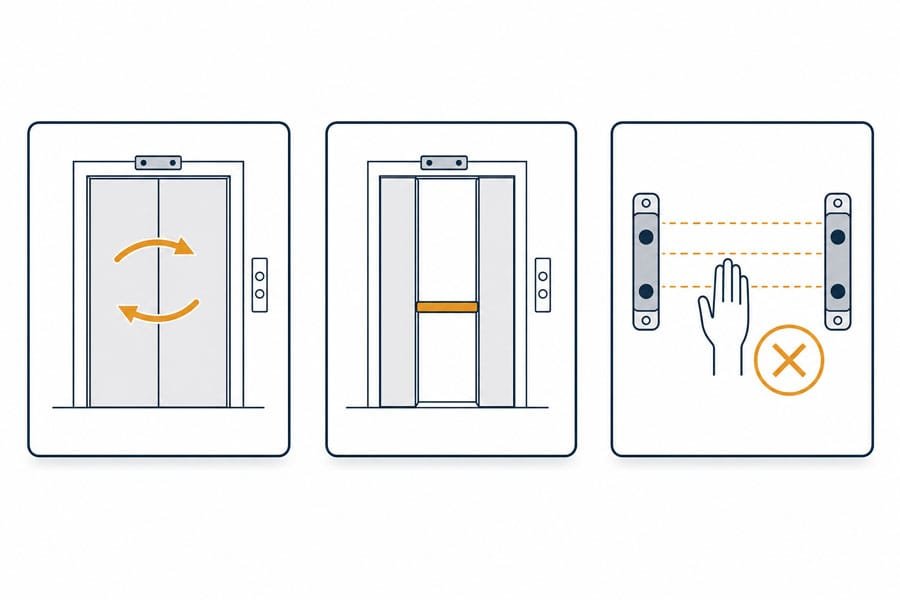
An elevator door sensor works by building a grid of infrared beams across the door opening. When any beam is blocked, the sensor sends an interrupt signal to the door operator, which stops closing the door and reopens it.
That is the short answer. The full picture involves four parts, a scanning sequence controlled by a microcontroller, and an output signal that the door operator must be able to read.
This guide explains the mechanism step by step, then covers the specifications that matter, the faults you will meet in the field, and how to choose a replacement.
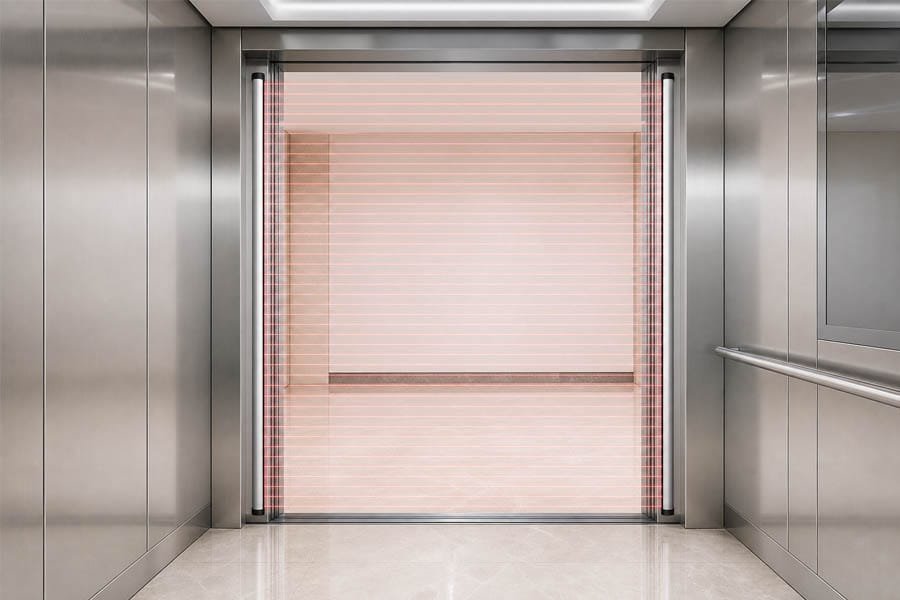
An elevator door sensor — also called an elevator light curtain, an infrared door sensor, or a door detector — is a safety device that protects passengers in the door opening and prevents entrapment.
A complete light curtain has four parts:
The transmitter and receiver are installed on opposite sides of the car door. They are not part of the door panel itself, and they never touch the passenger. Detection is entirely non-contact.
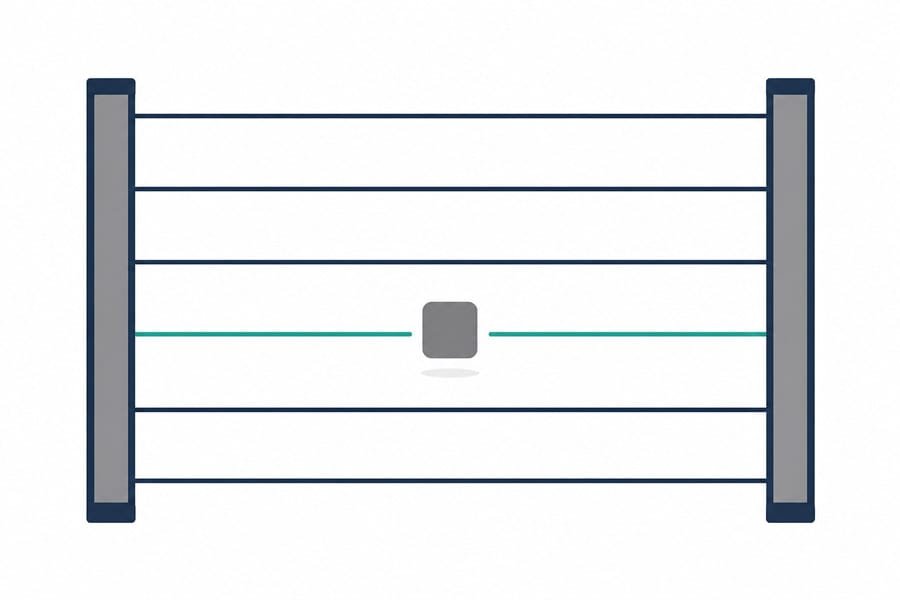
The transmitter bar contains a row of infrared emitting diodes. They do not all fire at once. A microcontroller inside the unit switches them on and off in a fixed sequence.
As each transmitter diode fires, several receiving diodes read the light. This creates multiple scanning paths from a single emission. Repeating this from top to bottom, many times per second, builds a dense grid of infrared beams across the door opening.
When a passenger, a hand, a trolley, or a pet interrupts any beam in the grid, that beam no longer reaches its receiver. The receiver circuit cannot complete the photoelectric conversion, and the sensor registers an obstruction.
Because the beam pattern is dense, the sensor does not need to be touched to react. A thin object such as a leash or a walking stick can be enough.
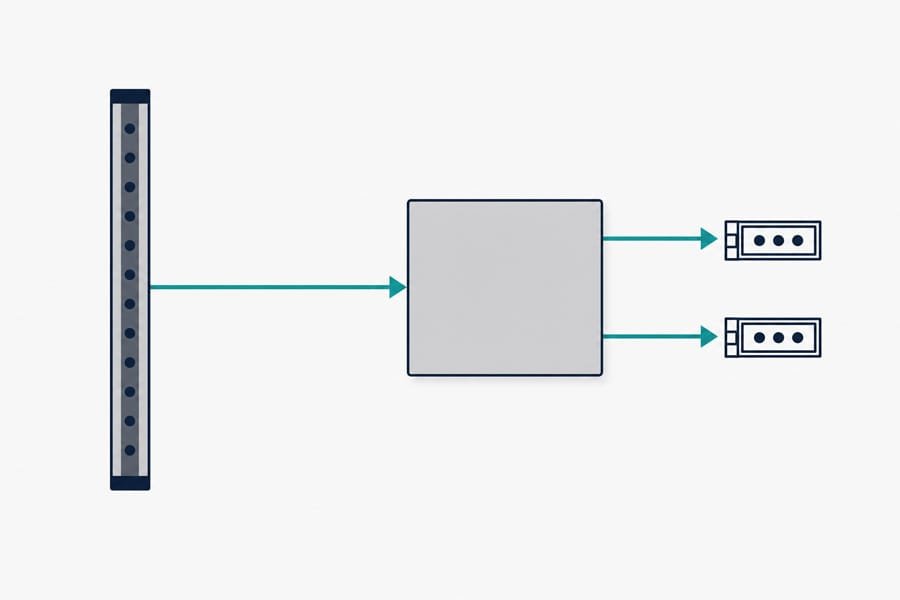
Once an obstruction is detected, the sensor sends an interrupt signal to the door operator. Depending on the model, this is either a switching output or a high/low level output.
On receiving the signal, the door operator immediately commands the door to stop closing and reverse to open. The door stays open until the obstruction clears the protected zone, and only then closes normally again.
That last point matters. The sensor does not simply pause the door. It triggers a reversal.
Understanding the output is essential when replacing a sensor, because a mismatched output will not work with the existing door operator.
Two output types are common:
Relay output — a mechanical contact, rated as normally open (NO), normally closed (NC), or 1NO/1NC. Response is slower because the relay must physically operate. Typical response times run from about 47 ms to 81 ms.
Transistor output (NPN or PNP) — a solid-state output. It responds faster than a relay, typically 42 ms to 76 ms, and has no moving parts to wear out. Its load capacity is limited, so it must match the door operator input.
Two connection arrangements also exist:
Direct connection, without a power box — the light curtain takes power directly from the door operator board, usually at DC 24 V. This is common in modernization work.
With a power box — a separate control box on the car top supplies power and handles the output. This is common in new installations and where the door operator cannot supply the required voltage.
A synchronization wire (often marked SYNC) runs between the transmitter and receiver to keep their timing aligned. It must be terminated at an isolated terminal on the car top.
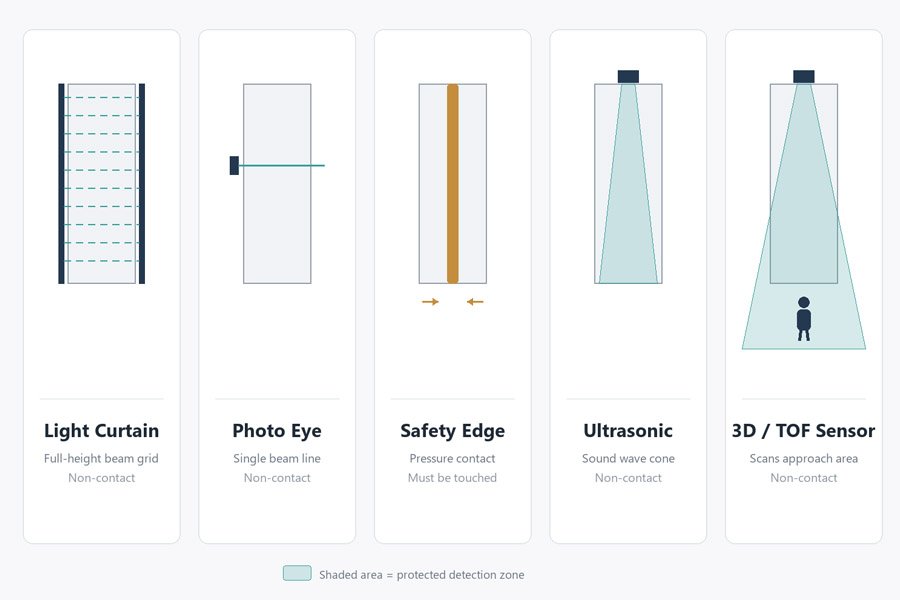
| Tipo | How it detects | Notas |
|---|---|---|
| Infrared light curtain | Grid of infrared beams | Most common today, non-contact |
| Photo eye (photocell) | One or a few beams | Older, large blind spots |
| Mechanical safety edge | Physical contact with the door edge | Older, reacts only after contact |
| Ultrasonic sensor | Sound waves | Rare |
| 3D / TOF sensor | Scans the area in front of the door | Growing in high-end buildings |
For most projects today, a light curtain is the correct choice. It protects the full door height without contact.
Resolution is the vertical distance between the centers of two adjacent infrared beams, measured in millimeters. A smaller resolution means denser beams, and a smaller object can be detected. In practice, resolution follows the diode spacing. Common spacings are 40 mm, 48 mm, 59 mm, 84 mm, and 118 mm.
Protection height is the vertical range the sensor covers. It must fully cover the actual door opening height. If the curtain is shorter than the opening, a blind zone remains at the top or bottom, and a small object can pass undetected.
Common curtains cover at least 1600 mm, with some models reaching 1800 mm or 1900 mm. The lowest beam usually sits 20 mm or less above the sill, so the sensor can detect a foot or a small object near the floor.
Response time is the delay between a beam being blocked and the output signal changing. It is measured in milliseconds. Shorter is safer, because the door starts to reverse sooner. This is the main reason relay outputs are slower than transistor outputs.
Light curtains are often described by beam count — 94, 154, 194, 234 beams, and so on. A higher count gives denser coverage.
The pattern matters as much as the number. In a cross-beam design, the diodes do not only fire straight across. They also fire at an angle, so one emission reaches several receivers along different paths. A high-density curtain combines horizontal beams, upward-slanted beams, and downward-slanted beams into a single interlaced grid.
This is why a modern curtain can detect a thin leash or a thin walking stick that a simple horizontal beam grid would miss.
When an elevator door sensor stops working, the symptom usually appears as one of three behaviours.
Also known as phantom reopening.
In all three cases, the first step separates the sensor from the door operator. Many reported sensor faults turn out to be wiring or door operator problems.
Replacing a light curtain is a compatibility problem more than a performance problem. Work through this list:
Price differences between models usually come down to four things: brand positioning, technical parameters such as resolution and response time, added functions such as foot detection or self-diagnosis, and after-sales support.
The same device goes by several names. In the elevator industry it is most often called a light curtain, or an elevator light curtain. It is also known as an elevator door detector, a door detector, an infrared light curtain, an infrared door sensor, an optical sensing edge, a multi-beam door sensor, or a door protection device. Older single-beam versions are called photo eyes or photocells. The name changes with brand and region, but all of them describe the same non-contact safety device.
Yes. Most modern elevator door sensors use infrared beams. The transmitter fires infrared diodes and the receiver reads them. Infrared is invisible to passengers, which is why the protection feels automatic.
A safety edge is a mechanical device that reacts only after the door physically touches a person or object. A light curtain reacts before contact, because the beam is interrupted first. Light curtains are the modern standard.
Common models range from about 94 beams to more than 230 beams. More beams mean denser coverage, but the beam pattern matters as much as the count. Cross-beam designs detect thin objects better than the same number of parallel beams.
The most common causes are dust on the curtain lenses, misalignment between the transmitter and receiver, direct sunlight, or electromagnetic interference. Cleaning and alignment checks solve many cases. If they do not, the curtain is likely failing.
It depends on the model and the wiring. Direct-connection types are simpler, because they take power from the door operator. Units with a power box involve more wiring. In either case, match the voltage, output type, and cable configuration exactly, and test the door before returning the elevator to service.
NO means normally open and NC means normally closed. They describe the state of the relay contact when no obstruction is detected. The setting must match what the door operator expects, or the door will behave incorrectly.
An elevator door sensor works by building a grid of infrared beams across the door opening, watching for any beam that fails to arrive, and sending an interrupt signal that makes the door operator reverse the door.
The mechanism is simple in principle, but it depends on several details working together: beam density, protection height, response time, output type, and correct wiring.
If you need a replacement light curtain, or you want help matching a model to your elevator, contact POTENCIAL. We supply elevator door sensors and light curtains for a wide range of door operators and elevator brands, and we can help you confirm the right specification before you order.