
Elevator ARD (Automatic Rescue Device) evacuates passengers when the power goes out. If the main supply fails, whether from a blackout, phase loss, or fire alarm, the ARD switches on within seconds and drives the car to the nearest floor so people can get out. Building codes in the EU (EN 81-20/50), China (GB 7588), and many other regions now require this kind of emergency evacuation provision.
POTENSI carries elevator ARD units for Mitsubishi, Otis, KONE, Thyssenkrupp, Hyundai, and other brands. We stock both new-installation and replacement units.
Elevator ARD, also known as an Automatic Rescue Operation Device, elevator emergency rescue device, or elevator UPS, is a battery-backed power supply designed for elevator systems. A generic office UPS will not work here. Elevator drives pull high inrush currents, dump regenerative loads back into the line, and need precise speed control during a rescue. An ARD handles all of that.
During normal operation the ARD sits idle. The CPU watches the main supply and keeps the battery pack charged.
When power drops, the CPU catches it within milliseconds and starts the rescue sequence.
The IGBT-based PWM inverter turns stored DC battery power into clean three-phase AC, matched to the elevator's voltage and frequency.
The car moves at reduced speed to the nearest landing, levels with the floor, and opens the doors.
Passengers walk out. The ARD drops to low power until mains return.
Once the supply comes back, the ARD returns to standby and starts recharging.
POTENSI supplies ARD units for all major elevator brands, but we recommend the Apollo series as our first choice.
Apollo TPS series is a common choice for three-phase elevator ARDs worldwide. It covers motor capacities from 5.5 kW to 32 kW, which is the range for most passenger and freight elevators in service today.
All TPS models use an IGBT-based PWM sine wave inverter, a smart CPU controller with LCD display, and a painted steel enclosure that holds up in machine rooms where humidity and dust are normal.
Need ARD for a different brand? Contact us — we can source it.

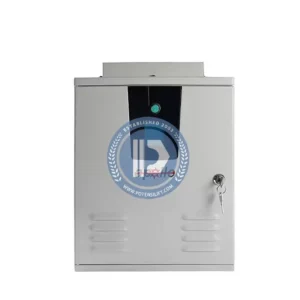
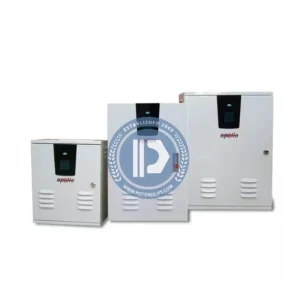
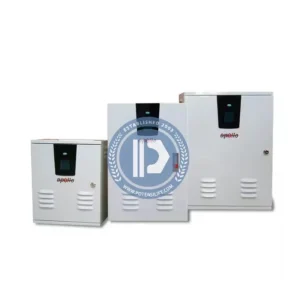
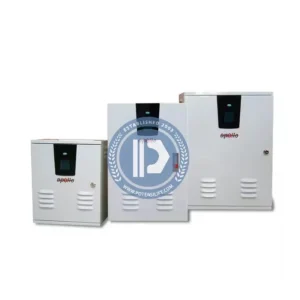
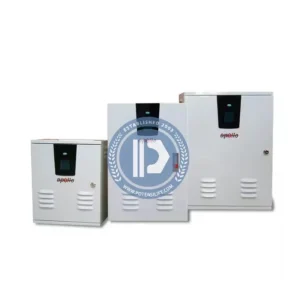
| Model | Capacity | DC Voltage | Battery (12V 7Ah) | AC Input |
|---|---|---|---|---|
| ARD TPS-10 | — | — | — | 380/415Vac 3-Phase |
| ARD TPS-11 | 5.5 kW | 36 Vdc | ×3 | 380/415Vac 3-Phase |
| ARD TPS-15 | 7.5 kW | 48 Vdc | ×4 | 380/415Vac 3-Phase |
| ARD TPS-25 | 12 kW | 60 Vdc | ×5 | 380/415Vac 3-Phase |
| ARD TPS-30 | 15 kW | 72 Vdc | ×6 | 380/415Vac 3-Phase |
| ARD TPS-39 | 18 kW | 84 Vdc | ×7 | 380/415Vac 3-Phase |
| ARD TPS-45 | 22 kW | 96 Vdc | ×8 | 380/415Vac 3-Phase |
| ARD TPS-60 | 25 kW | 120 Vdc | ×10 | 380/415Vac 3-Phase |
| ARD TPS-100 | 32 kW | 144/180 Vdc | ×12/×15 | 380/415Vac 3-Phase |
Some buildings run single-phase power to the elevator. The ARD-10 through ARD-60 series accepts both single-phase (220V/110V) and three-phase (415V/220V) input, so it fits those installations too.
ARD-10 through ARD-30 share a 530×408×195 mm housing. ARD-40, ARD-45, and ARD-60 use the larger 590×458×195 mm housing. Both series use the same IGBT PWM sine wave inverter (85% efficiency, <3% THD). Output can be single-phase (220V/110V) or three-phase (400V/415V/200V).
| Model | Capacity | DC Voltage | AC Input (1-Phase) | AC Input (3-Phase) | Dimensions (W×H×D) |
|---|---|---|---|---|---|
| ARD-10 | 5.5 kW (7.5HP) | 48 Vdc | 220Vac/110Vac, 50/60Hz ±10% | 415Vac/220Vac +15%/-20%, 50/60Hz ±10% | 530 × 408 × 195 mm |
| ARD-15 | 8.2 kW (11HP) | 60 Vdc | 220Vac/110Vac, 50/60Hz ±10% | 415Vac/220Vac +15%/-20%, 50/60Hz ±10% | 530 × 408 × 195 mm |
| ARD-25 | 16.5 kW (22HP) | 72 Vdc | 220Vac/110Vac, 50/60Hz ±10% | 415Vac/220Vac +15%/-20%, 50/60Hz ±10% | 530 × 408 × 195 mm |
| ARD-30 | 22 kW (26HP) | 84 Vdc | 220Vac/110Vac, 50/60Hz ±10% | 415Vac/220Vac +15%/-20%, 50/60Hz ±10% | 530 × 408 × 195 mm |
| ARD-40 | 26 kW (35HP) | 96 Vdc | 220Vac/110Vac, 50/60Hz ±10% | 415Vac/220Vac +15%/-20%, 50/60Hz ±10% | 590 × 458 × 195 mm |
| ARD-45 | 28 kW (39HP) | 120 Vdc | 220Vac/110Vac, 50/60Hz ±10% | 415Vac/220Vac +15%/-20%, 50/60Hz ±10% | 590 × 458 × 195 mm |
| ARD-60 | 32 kW (45HP) | 144 Vdc | 220Vac/110Vac, 50/60Hz ±10% | 415Vac/220Vac +15%/-20%, 50/60Hz ±10% | 590 × 458 × 195 mm |
Match the ARD to your elevator motor’s rated power:
Not sure which one? Contact our team and tell us your elevator specs. We will point you to the right model.
| Parameter | TPS Series (3-Phase) | ARD-10~60 Series (1/3-Phase) |
|---|---|---|
| AC Input | 380/415Vac ±20%, 3-phase | 1-phase: 220/110Vac ±10%; 3-phase: 415/220Vac +15%/-20% |
| Input Frequency | 50/60Hz ±10% | 50/60Hz ±10% |
| Output Voltage | 380/415Vac, 3-phase | 1-phase: 220/110Vac; 3-phase: 400/415/200Vac |
| Output Frequency | 50/60Hz ±0.1Hz | 50/60Hz ±0.1Hz |
| Charger | Controlled Rectifier CVCC, 10h to 90% | Controlled Rectifier CVCC, 10h to 90% |
| Inverter | IGBT-based PWM sine wave | IGBT-based PWM sine wave |
| Efficiency | 85% | 85% |
| Overload | 105% continuous | 105% continuous |
| THD | < 3% (linear load) | < 3% (linear load) |
| Crest Factor | 4:1 | 4:1 |
| Power Factor | 0.8 | 0.8 |
| Phase Shift | 120° ±1° | 120° ±1° |
| Display | LCD, blue backlight | LCD, blue backlight |
| Protection | Overload, short circuit, DC over/under-voltage | Overload, short circuit, DC over/under-voltage |
| Enclosure | Painted steel | Painted steel |
| Dimensions | — | 530×408×195mm (ARD-10 |
| Optional | Manual rescue function | — |
Code compliance
EN 81-20/50 (Europe), GB 7588 (China), and a growing number of national building codes now require an automatic rescue device or an equivalent emergency evacuation system. If you are installing or modernizing elevators in these markets, an ARD is not optional.
Passenger safety
Without an ARD, a power outage means people are stuck in the car until the utility restores power or a technician performs a manual rescue. The problems are real: panic (especially among the elderly or claustrophobic), medical risk for passengers who need immediate attention, legal exposure for building owners, and reputation damage for hotels and hospitals.
Less downtime
In a commercial building, a manual rescue can take 30 minutes or more once you factor in the call-out, travel time, and the rescue procedure itself. An ARD levels the car and opens the doors automatically, usually within a minute or two. That is the difference between a brief interruption and a building-wide incident.
ARD stands for Automatic Rescue Device. It is a battery-backed emergency power supply that drives the elevator to the nearest floor and opens the doors when the main power fails.
A regular UPS provides backup power. An elevator ARD does that too, but it also handles the specific demands of elevator drives: high inrush currents, regenerative loads, and controlled speed during the rescue run. It also includes sequencing logic that talks to the elevator controller to carry out the rescue in the right order. Plug a standard UPS into an elevator and it will trip on the first inrush.
The battery is not there for extended runtime. Its job is to get the car to the nearest floor, which usually takes 30 seconds to 2 minutes. The battery sits on continuous float charge and lasts about 3 to 5 years in normal service.
Yes. Most ARD units are built for retrofit. The ARD sits between the main supply and the elevator drive. Wiring changes are minimal.
Test the battery every 6 months. Check connections and enclosure condition on the same schedule. Read the LCD display to confirm the unit reports no faults. Most modern ARDs run self-diagnostics automatically, but a physical battery load test is still the reliable way to know the pack is healthy.
It depends on the elevator's electrical specs, not the brand name. The Apollo ARD works on any elevator where the motor voltage, power rating, and control system match the ARD's output. In practice, Apollo ARDs are installed on Mitsubishi, Otis, KONE, Thyssenkrupp, Hyundai, and many other brands' elevators. If you are not sure about compatibility, send us your elevator model and specs — we will confirm.
The TPS series (TPS-10 through TPS-100) is three-phase only, with 380/415Vac input. The ARD-10/15/25/30/40/45/60 series accepts both single-phase (220V/110V) and three-phase (415V/220V) input, which matters for older buildings wired with single-phase power. Both use the same IGBT inverter and smart CPU control.
Elevator Traction machine
Elevator Wire Rope
Elevator Traction Belt
Elevator Inverter
Elevator PCB
Elevator Encoder
Elevator Door Controller
Elevator Door Motor
Elevator Door Sensor
Elevator Fans and AC
Elevator COP & LOP & Buttons
Elevator Sheaves
Elevator Guide Shoe & shoe liner
Elevator Compensation chain
Elevator ARD
Others Elevator Parts
① Get 10% off on your first order.
② Get latest news about our promotion products.
③ Get our sales specialist VIP service 24/7.
④ Get access to our credit payment time.

WhatsApp us